


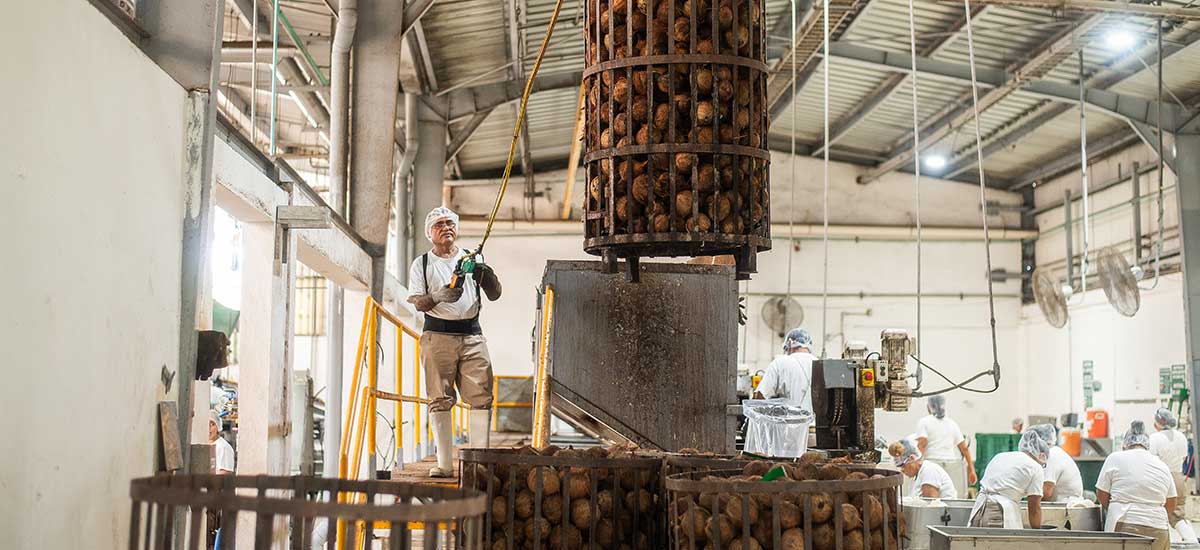
From Waste to Green Gold
In the food and beverage industry, waste management is one of the biggest logistical and environmental challenges. While linear models (extract, use, dispose of) generate large volumes of waste and a high operating cost, the Circular Economy proposes a new paradigm: Waste is raw material.
In Coco Colima, with more than 70 years of experience as a company vertically integrated in the Mexican Pacific, circularity is not a trend, but rather the fundamental principle of our operation. We understand the coconut as the “Tree of Life” and we have perfected the comprehensive use of each of its parts.
This article details how the approach of Zero waste de Coco Colima creates value for our B2B partners, offering a more efficient, sustainable supply chain with a portfolio of functional bioproducts derived from what others consider to be waste.
1. The Waste Challenge and the Advantage of the Integrated Model
When coconut is industrialized to obtain oil, cream, water or dehydrated products, up to 85% of the fruit is lignocellulosic material (shell, fiber, burlap), which must be managed. Historically, this waste ended up in landfills or was incinerated, generating methane emissions and loss of nutrients in the soil.
Coco Colima's main strength lies in its vertical chain control: by managing from the palm to the production plant, we can guarantee that 100% of the fruit enters a value-added cycle.
Authorized Input (Environment): La FAO (United Nations Food and Agriculture Organization) promotes the comprehensive use to mitigate the environmental impact of agro-industrial waste, coconut being an ideal example due to the versatility of its biomass.
2. Structural Bioproducts: Value of Fiber and Shell
The most cost-effective transformation of the coconut circular economy focuses on the bulkiest and least exploited part: the outer shell or burlap (source of fiber) and the inner shell (source of carbon).
a) Coconut Fiber (Substrates and Construction)
Coconut fiber (or coir), obtained from the mesocarp of the fruit, is a material with unique properties:
- B2B Hydroponics: It is an excellent agricultural substrate for protected crops (greenhouses). Its balance between water retention and aeration improves the yield of horticultural crops, allowing our agricultural customers to save up to 30% in water consumption.
- Insulation and Construction: Treated fiber is increasingly used in construction because of its fire resistance and its light weight, replacing less ecological materials.
b) Activated Carbon and Biofuel
The hard and woody inner shell undergoes pyrolysis (carbonization) to obtain:
- Activated Carbon: A high value product in the pharmaceutical, filtration (water and air purification) and cosmetic industries. Its porous structure makes it superior for the adsorption of impurities.
- Thermal Energy: The waste biomass is converted into fuel for the plant itself, achieving energy self-sufficiency and reducing dependence on fossil fuels, in line with the decarbonization objectives of our B2B customers.
3. From Liquid Waste to Nutrients
Even the wet by-products that remain after the extraction of pulp and oil are reincorporated into the cycle, eliminating effluent contamination.
- Water Reuse: The water used in washing processes is treated and reincorporated into the system, or is used for irrigation in plantations, optimizing water resources, a priority of ESG management.
- Natural Fertilization: The organic remains and the sediment are composted and returned to the soil of the Colima plantations themselves, acting as a soil improver natural that reduces the need for agrochemicals and preserves the fertility of Terroir.
4. The B2B Value of Circular Certification
For an industrial buyer, choosing Coco Colima isn't just a sourcing decision, it's a statement of commitment to sustainability.
The Circular Economy model:
- Reduce the Footprint: It reduces the carbon and water footprint of the raw material, allowing our customers to improve their own sustainability reports (ESG).
- Guarantees the Supply: By creating value in multiple flows (food, bioproducts, energy), the chain becomes more resilient to market fluctuations.
- Reinforce the Branding: Offers a powerful and verifiable story of comprehensive utilization, which the B2B customer can use to position their final products before an increasingly aware consumer.
Conclusion: Cultivating a Sustainable Future
In Coco Colima, innovation lies in efficiency. By integrating agribusiness under a Circular Economy principle, we have converted every part of the Colima coconut into a high-value ingredient or bioproduct.
We offer the industry the opportunity to partner with a brand that not only delivers quality and volume, but is also a engine of sustainability and regional development.
Working with Coco Colima is investing in a forward-looking supply chain: efficient, responsible and fully integrated.
Learn how our bioproducts and our circular model can optimize your costs and your ESG strategy.Contact us for a specialized consultation on the full use of coconut.


B2B traceability: From the palm to your plant. The new standard of origin.


Colima: Where coconut is more than fruit, it is the social and root engine.


Copyright © Coco Colima | Designed By Visualis Studio